pto.trowexpandadd
pto.trowexpandadd is part of the Reduce And Expand instruction set.
Summary
Row-wise broadcast add: add a per-row scalar vector.
Mechanism
Row-wise broadcast add: add a per-row broadcast operand to each row of src0.
Mode 1 — Scalar per row (ColMajor expanded operand)
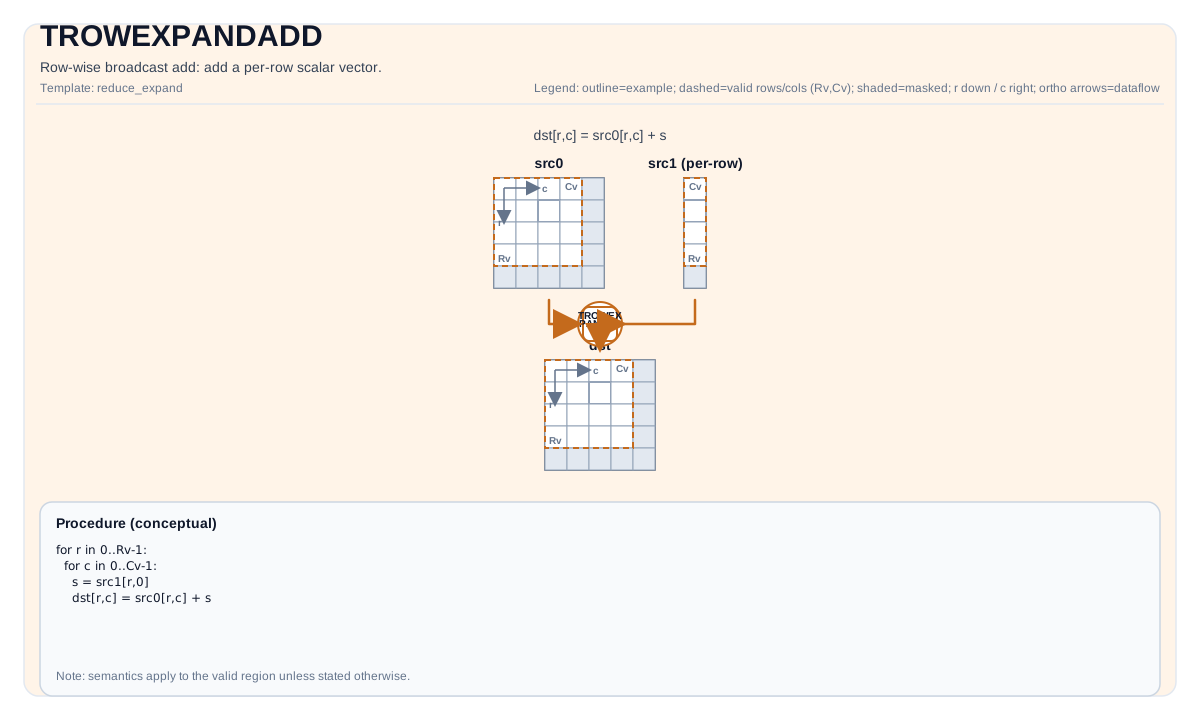
Let R = dst.GetValidRow() and C = dst.GetValidCol(). Let s_i be the per-row scalar taken from the expanded operand.
For 0 <= i < R and 0 <= j < C:
Mode 2 — 32-byte block per row (RowMajor expanded operand)
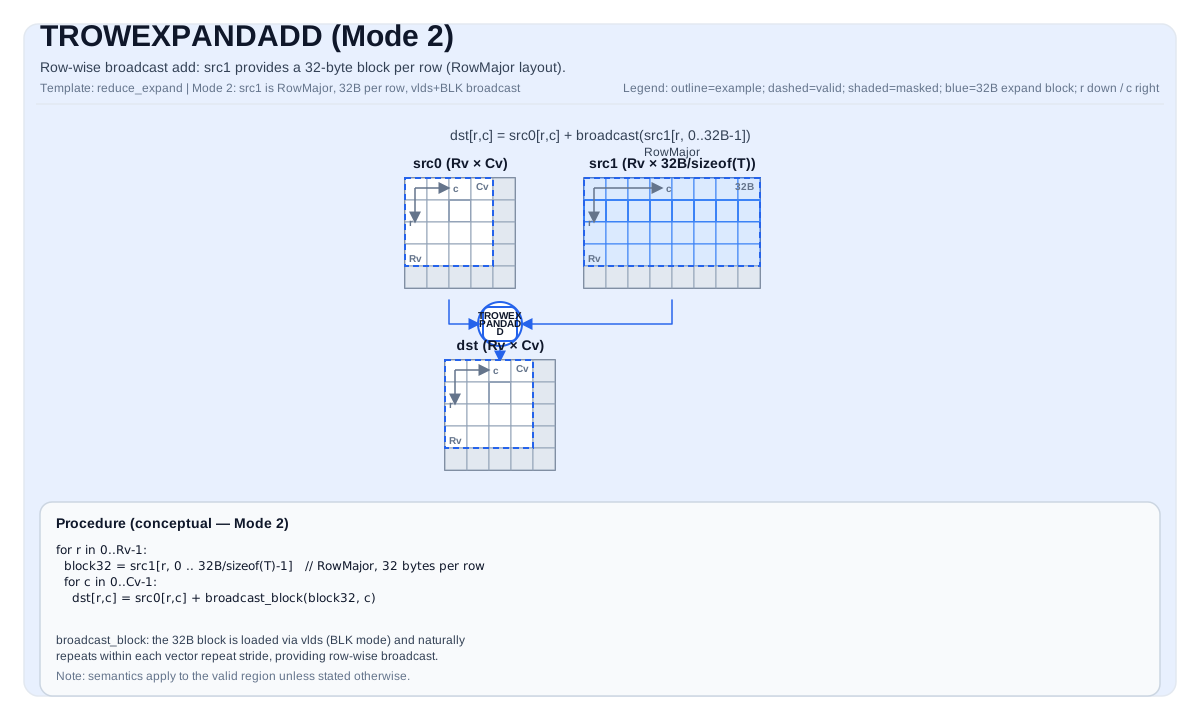
Let b_i be the 32-byte block for row i taken from the expanded operand. The block contains 32 / sizeof(T) values and repeats across the row.
For 0 <= i < R and 0 <= j < C:
Syntax
Textual spelling is defined by the PTO ISA syntax-and-operands pages.
Synchronous form:
%dst = trowexpandadd %src0, %src1 : !pto.tile<...>, !pto.tile<...> -> !pto.tile<...>AS Level 1 (SSA)
%dst = pto.trowexpandadd %src0, %src1 : !pto.tile<...>, !pto.tile<...> -> !pto.tile<...>AS Level 2 (DPS)
pto.trowexpandadd ins(%src0, %src1 : !pto.tile_buf<...>, !pto.tile_buf<...>) outs(%dst : !pto.tile_buf<...>)C++ Intrinsic
Declared in include/pto/common/pto_instr.hpp:
template <typename TileDataDst, typename TileDataSrc0, typename TileDataSrc1, typename... WaitEvents>
PTO_INST RecordEvent TROWEXPANDADD(TileDataDst &dst, TileDataSrc0 &src0, TileDataSrc1 &src1, WaitEvents &... events);

template <typename TileDataDst, typename TileDataSrc0, typename TileDataSrc1, typename TileDataTmp,
          typename... WaitEvents>
PTO_INST RecordEvent TROWEXPANDADD(TileDataDst &dst, TileDataSrc0 &src0, TileDataSrc1 &src1, TileDataTmp &tmp, WaitEvents &... events);Inputs
src0is the first source tile (the tile to be modified).src1is the second source tile providing per-row scalar values.tmp(optional): temporary tile for intermediate storage.dstnames the destination tile. The operation iterates over dst's valid region.
Expected Outputs
dst[i,j] = src0[i,j] + src1[i,0] (row-wise broadcast add of per-row scalar).
Side Effects
No architectural side effects beyond producing the destination tile. Does not implicitly fence unrelated traffic.
Constraints
Constraints
-
TileDataDst::DType == TileDataSrc0::DType == TileDataSrc1::DType. -
TileDataDst::DType,TileDataSrc0::DType, andTileDataSrc1::DTypemust be one of:half,float,int16,int32for A2, A3, and A5;uint16,uint32for A5. -
TileDataDstmust be RowMajor. -
Exactly one of
src0orsrc1must have the same valid shape asdst. That operand is the full-sized operand; the other operand is the expanded row-broadcast operand. -
The full-sized operand must be RowMajor.
-
Mode 1: the expanded operand is ColMajor, has valid column count 1, and has valid row count equal to
dst.GetValidRow(). -
Mode 2: the expanded operand is RowMajor, has valid row count equal to
dst.GetValidRow(), and has valid column count32 / sizeof(T): 16 for 16-bit types and 8 for 32-bit types. -
Exact layout, fractal, and alignment constraints are target-specific; see backend headers under
include/pto/npu/*/TRowExpand*.hpp.
Temporary tile
The C++ API provides an overload with an explicit TileDataTmp &tmp. This overload only supports Mode 1 (ColMajor expanded operand, scalar per row).
- A2A3: The tmp tile is used as a broadcast buffer. The per-row scalar values from the ColMajor expanded operand are broadcast via the
vbrcbinstruction into the tmp buffer, creating a 32-byte block per row, which is then used as the expanded operand in the binary operation. Thevbrcbinstruction uses a repeat stride of 8 blocks (256 bytes) between repeat groups, processing 8 rows per repeat. Minimum tmp size calculation:- Common parameters:
R = dst.GetValidRow(),T = TileDataDst::DType. - For
R < 256: $$ \text{tmpSize} = \left\lceil\frac{R}{8}\right\rceil \times 256 \text{ bytes} $$ - For
R >= 256, the operation is looped with at most 30 repeats (240 rows) per loop iteration. The tmp buffer is reused across loops, so the per-loop requirement is: $$ \text{tmpSize} = 30 \times 256 = 7680 \text{ bytes} $$ - A compact shape-independent upper bound for any Mode 1 invocation is 8 KB (8192 bytes).
- The 3-arg overload without
tmpsupports both Mode 1 and Mode 2. For Mode 1, it uses an internal 8 KB buffer (TMP_UB_OFFSET). For Mode 2, no broadcast buffer is needed.
- Common parameters:
- A5: The
tmptile is accepted and ignored ([[maybe_unused]]). A5 hardware supports row-broadcast natively via thevldsinstruction's broadcast modes, so no scratch buffer is required.
Exceptions
Exceptions
- Illegal operand tuples, unsupported types, invalid layout combinations, or unsupported target-profile modes are rejected by the verifier or by the selected backend instruction set.
- Programs must not rely on behavior outside the documented legal domain of this operation, even if one backend currently accepts it.
Target-Profile Restrictions
Target-Profile Restrictions
-
pto.trowexpandaddpreserves PTO-visible semantics across CPU simulation, A2/A3-class targets, and A5-class targets, but concrete support subsets may differ by profile. -
Portable code must rely only on the documented type, layout, shape, and mode combinations that the selected target profile guarantees.
Examples
Auto
#include <pto/pto-inst.hpp>

using namespace pto;

void example_auto() {
  using SrcT = Tile<TileType::Vec, float, 16, 16>;
  using DstT = Tile<TileType::Vec, float, 16, 16>;
  using RowVecT = Tile<TileType::Vec, float, 16, 1, BLayout::ColMajor>;
  SrcT src0;
  DstT dst;
  RowVecT src1;
  // Row-expand-add: each row of dst = src0.row + src1.row_scalar
  TROWEXPANDADD(dst, src0, src1);
}Manual
#include <pto/pto-inst.hpp>

using namespace pto;

void example_manual() {
  using SrcT = Tile<TileType::Vec, float, 16, 16>;
  using DstT = Tile<TileType::Vec, float, 16, 16>;
  using RowVecT = Tile<TileType::Vec, float, 16, 1, BLayout::ColMajor>;
  SrcT src0;
  DstT dst;
  RowVecT src1;
  TASSIGN(src0, 0x1000);
  TASSIGN(dst, 0x2000);
  TASSIGN(src1, 0x3000);
  // Row-expand-add in manual mode
  TROWEXPANDADD(dst, src0, src1);
}
Auto Mode
# Auto mode: compiler/runtime-managed placement and scheduling.
%dst = pto.trowexpandadd %src0, %src1 : !pto.tile<...>, !pto.tile<...> -> !pto.tile<...>
Manual Mode
# Manual mode: bind resources explicitly before issuing the instruction.
# Optional for tile operands:
# pto.tassign %arg0, @tile(0x1000)
# pto.tassign %arg1, @tile(0x2000)
%dst = pto.trowexpandadd %src0, %src1 : !pto.tile<...>, !pto.tile<...> -> !pto.tile<...>
PTO Assembly Form
%dst = trowexpandadd %src0, %src1 : !pto.tile<...>, !pto.tile<...> -> !pto.tile<...>
# AS Level 2 (DPS)
pto.trowexpandadd ins(%src0, %src1 : !pto.tile_buf<...>, !pto.tile_buf<...>) outs(%dst : !pto.tile_buf<...>)
Related Ops / Instruction Set Links
- Instruction set overview: Reduce And Expand
- Previous op in instruction set: pto.trowexpandsub
- Next op in instruction set: pto.trowexpandmax