pto.tquant
pto.tquant is part of the Irregular and Complex tile instruction family.
Tile Operation Diagram
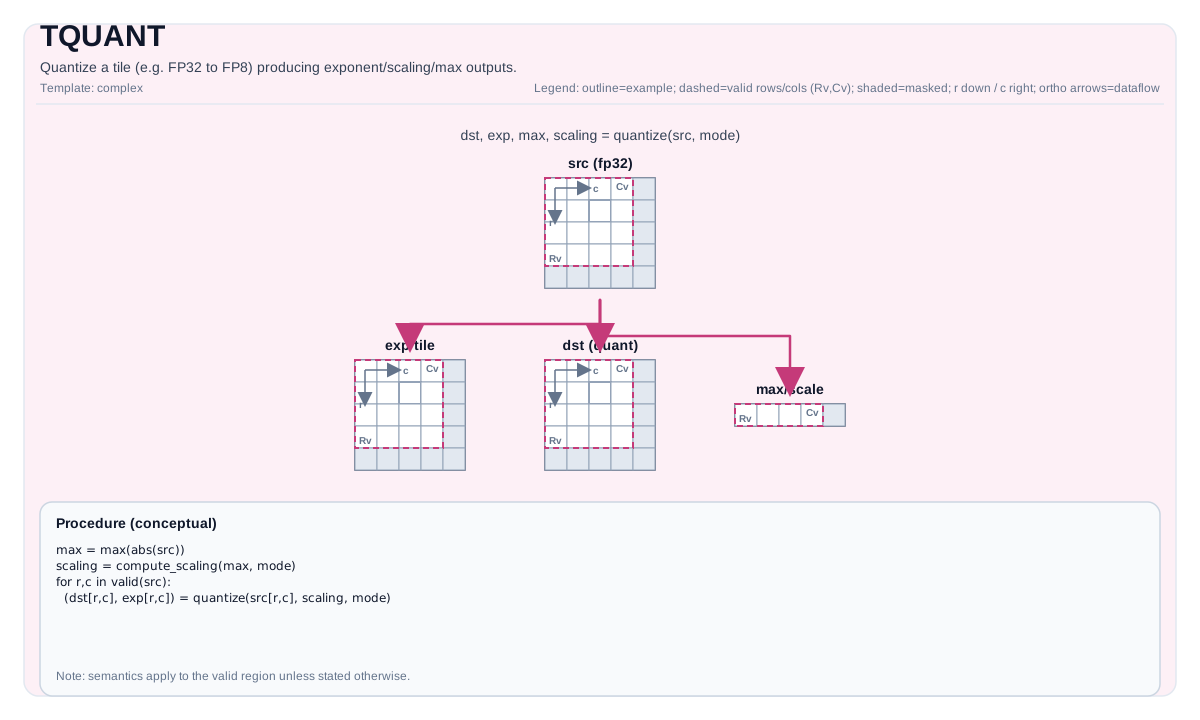
Introduction
Quantize a higher-precision tile (FP32 / BF16 / FP16) into a lower-precision format, producing the quantized data tile plus auxiliary per-group exponent / max / scaling tiles. The destination format, scale algorithm, and group axis are compile-time template parameters.
| Destination family | Formats | Grouping | Scale algorithm |
|---|---|---|---|
| Microscaling (MX) | MXFP8 (e4m3), MXFP4 (e2m1) | 32 elements per shared-exponent group | OCP, NV |
| Integer | INT8 (symmetric / asymmetric) | per-tile scale (+ optional offset) | affine |
Quantization Process
MX formats (3 stages, group size G = 32)
For a tile \(x \in \mathbb{R}^{M \times N}\) grouped along axis grp_axis (ND: axis-1/columns, DN: axis-0/rows):
| Stage | Operation | Output |
|---|---|---|
| 1. Group max | \(m_g = \max_{i \in g} \|x_i\|\) | max (scratch, FP) |
| 2. Exponent + scale | \(s_g = \mathrm{biasedExp}(m_g) - e_{\max}\); \(\alpha_g = 2^{254 - s_g}\) | exp (E8M0, 1 B/group), scaling (scratch, FP) |
| 3. Scale + cast | \(q_i = \mathrm{clip}_{[-V_{\max},V_{\max}]}(x_i \cdot \alpha_g) \to\) dest format | dst (FP8 / packed FP4) |
- \(e_{\max}\) = max destination exponent (8 for e4m3, 1 for e2m1).
- \(V_{\max}\) = destination MAX_NORM (448 for e4m3, 6 for e2m1).
- Stages 1–2 use exact IEEE-754 bit manipulation (no FP
log/floor); stage 3 uses hardware cast with stochastic rounding (SPR.CTRL[50]=1). - ND ("normal direction",
grp_axis=1): groups of 32 consecutive columns — the default/standard grouping. DN (grp_axis=0): groups of 32 consecutive rows — a transposed-style grouping along axis-0; exponent tile shapeM̂×N,M̂ = M/32.
Integer INT8 (affine, 5-stage cast)
No group structure; scale (and asymmetric offset) are per-tile FP32 scalars/vectors. To avoid double-rounding on A2/A3, the cast chain is FP32 → S32 → FP32 → FP16 → INT8 (5 stages, via a tmp tile = src size); A5 uses native broadcast + cast (no tmp). Input must be FP32.
C++ Intrinsics
Declared in include/pto/common/pto_instr.hpp.
MX — grouped (grp_axis + MxQuantAlg) — recommended
template <int grp_axis, auto mx_alg, typename TileDataOut, typename TileDataSrc,
          typename TileDataExp, typename TileDataMax, typename TileDataScaling, typename... WaitEvents>
PTO_INST RecordEvent TQUANT(TileDataOut &dst, TileDataSrc &src, TileDataExp *exp, TileDataMax *max,
TileDataScaling *scaling, WaitEvents &...events);| Template param | Values | Meaning |
|---|---|---|
grp_axis |
0 = DN (axis-0 groups), 1 = ND (axis-1 groups) |
Quantization group axis |
mx_alg |
MxQuantAlg::OcpMxFp8E4M3, NvMxFp8E4M3, OcpMxFp4E2M1, NvMxFp4E2M1 |
Format + scale algorithm |
MX — ND legacy (QuantType + QuantScaleAlg)
template <auto quant_type, typename ...Tiles, auto scale_alg = QuantScaleAlg::OCP, typename... WaitEvents>
PTO_INST RecordEvent TQUANT(TileDataOut &dst, TileDataSrc &src, TileDataExp *exp, TileDataMax *max,
                            TileDataScaling *scaling, WaitEvents &...events);

// with explicit ZZ exponent store-mode
template <auto quant_type, auto store_mode, typename ...Tiles, typename... WaitEvents>
PTO_INST RecordEvent TQUANT(TileDataOut &dst, TileDataSrc &src, TileDataExp *exp, TileDataMax *max,
                            TileDataScaling *scaling, TileDataExp *exp_zz, WaitEvents &...events);
quant_type |
Format | scale_alg |
|---|---|---|
QuantType::MXFP8 |
e4m3 + E8M0 | OCP / NV |
QuantType::MXFP4_E2M1 |
e2m1 + E8M0 | OCP / NV |
Integer INT8
// symmetric
template <auto quant_type, typename TileDataOut, typename TileDataSrc, typename TileDataPara, typename... WaitEvents>
PTO_INST RecordEvent TQUANT(TileDataOut &dst, TileDataSrc &src, TileDataPara &scale,
                            TileDataPara *offset = nullptr, WaitEvents &...events);
// with explicit scratch (A2/A3)
template <auto quant_type, typename ...Tiles, typename TileDataTmp, typename... WaitEvents>
PTO_INST RecordEvent TQUANT(TileDataOut &dst, TileDataSrc &src, TileDataPara &scale, TileDataTmp &tmp,
                            TileDataPara *offset = nullptr, WaitEvents &...events);
quant_type |
offset |
dst dtype |
Mode |
|---|---|---|---|
QuantType::INT8_SYM |
nullptr |
int8_t |
symmetric (\(q = \mathrm{round}(x/\mathrm{scale})\)) |
QuantType::INT8_ASYM |
provided | uint8_t |
asymmetric (\(q = \mathrm{round}(x/\mathrm{scale}) + \mathrm{offset}\)) |
The
tmp-aware overload (dst, src, scale, tmp, offset) exists for A2/A3 interface parity. On A5tmpis unused; on A2/A3 it must beM×NFP32 (the S32 cast intermediate).
Tile Sizes & Data Types
For an input tile of shape \(M \times N\) elements (dtype \(T \in \{\mathrm{FP32}, \mathrm{BF16}, \mathrm{FP16}\}\)), group size \(G = 32\):
MXFP8 (e4m3)
| Tile | dtype | Shape (ND) | Shape (DN) | Bytes |
|---|---|---|---|---|
src |
\(T\) | \(M \times N\) | \(M \times N\) | \(M \cdot N \cdot \mathrm{sizeof}(T)\) |
dst |
int8_t (e4m3 alias) |
\(M \times N\) | \(M \times N\) | \(M \cdot N\) |
exp |
uint8_t (E8M0) |
\(M \times N/32\) | \(M/32 \times N\) | \(M \cdot N / 32\) |
max (scratch) |
\(T\) | \(M \times N/32\) | \(M/32 \times N\) | \(M \cdot N / 32 \cdot \mathrm{sizeof}(T)\) |
scaling (scratch) |
\(T\) | \(M \times N/32\) | \(M/32 \times N\) | \(M \cdot N / 32 \cdot \mathrm{sizeof}(T)\) |
MXFP4 (e2m1)
Same as MXFP8 except:
| Tile | dtype | Bytes |
|------|-------|-------|
| dst | float4_e2m1x2_t (2 e2m1 codes packed per byte) | \(M \cdot N / 2\) |
Input restriction: MXFP4 accepts FP16/BF16 only (not FP32).
INT8
| Tile | dtype | Shape | Bytes |
|---|---|---|---|
src |
float32_t |
\(M \times N\) | \(M \cdot N \cdot 4\) |
dst (SYM) |
int8_t |
\(M \times N\) | \(M \cdot N\) |
dst (ASYM) |
uint8_t |
\(M \times N\) | \(M \cdot N\) |
scale |
FP32 scalar/vector | per-tile | — |
offset (ASYM) |
FP32 scalar/vector | per-tile | — |
tmp (A2/A3 only) |
FP32 | \(M \times N\) | \(M \cdot N \cdot 4\) |
tmptile (A2/A3 only): must be the same size assrc(\(M \times N\) FP32 = \(4MN\) bytes). It holds the FP32→S32 intermediate (A3 has no in-placetcvt). A5 accepts the sametmpargument for interface parity but does not use it (A5 broadcasts scale/offset natively viavlds BRC_B32).
Constraints
| Constraint | Applies to | Reason |
|---|---|---|
| \(M \bmod 16 = 0\) | ND MX (ZZ layout) | 16-row ZZ blocks |
| \(M \bmod 32 = 0\) | DN MX | axis-0 group divisibility |
| \(M \bmod 64 = 0\) | DN MX + ZZ conversion | δ-pairing (\(\hat M / 2\) integer) |
| \(N \bmod 32 = 0\) | all MX | group size \(G = 32\) |
| \(N \bmod 64 = 0\) | ND MX + ZZ conversion | even number of exponent groups |
| \(R \cdot C \le 59461\) | MX (UB 256 KB) | buffer budget with reuse |
BF16/FP16: validCols % 32 != 0 → zero-padded to StaticCols |
MX B16 path | group alignment |
Output Layout & Layout Conversion
TQUANT writes ND (row-major) output by default. The Cube Unit consumes two fractal layouts, produced by separate TMOV instructions:
| Output | Native (TQUANT) | Cube layout | Conversion |
|---|---|---|---|
| FP8 / FP4 data | ND | NZ (ColMajor+RowMajor fractal) | TMOV(dstNZ, dst) (2-arg) |
| E8M0 exponents (ND groups) | ND | ZZ (zigzag, [16,2] boxes) |
TMOV(e8Zz, e8, tmp) (3-arg) |
| E8M0 exponents (DN groups) | DN | ZZ | TMOV<0>(e8Zz, e8Dn, tmp) (3-arg, grp_axis=0) |
DN data FP8 mantissas share the same physical addresses as ND (the (r,c) element is identical), so the 2-arg TMOV ND→NZ is correct for DN data unchanged. Only the exponent path differs (DN→ZZ via TMOV<0>). See TQUANT_DN.md for the DN→ZZ transform.
Supported Input Dtypes
| Format | Accepted input dtypes | Notes |
|---|---|---|
| MXFP8 | FP32, BF16, FP16 | FP32: in-place FP8 output (4:1). BF16/FP16: source zero-padded to StaticCols; upcast to FP32 before cast (no direct b16→e4m3). |
| MXFP4 (e2m1) | FP16, BF16 only (not FP32) | output float4_e2m1x2_t (packed). |
| INT8 (sym/asym) | FP32 only | SYM→int8_t, ASYM→uint8_t. A2/A3 need tmp = src size. |
Math Interpretation
Unless otherwise specified, semantics are defined over the valid region and target-dependent behavior is marked as implementation-defined.
Assembly Syntax
AS Level 1 (SSA)
%dst = pto.tquant %src, %qp : (!pto.tile<...>, !pto.tile<...>) -> !pto.tile<...>AS Level 2 (DPS)
pto.tquant ins(%src, %qp : !pto.tile_buf<...>, !pto.tile_buf<...>) outs(%dst : !pto.tile_buf<...>)ASM Form Examples
Auto Mode
# Auto mode: compiler/runtime-managed placement and scheduling.
%dst = pto.tquant %src, %qp : (!pto.tile<...>, !pto.tile<...>) -> !pto.tile<...>
Manual Mode
# Manual mode: resources must be bound explicitly before issuing the instruction.
# Optional for tile operands:
# pto.tassign %arg0, @tile(0x1000)
# pto.tassign %arg1, @tile(0x2000)
%dst = pto.tquant %src, %qp : (!pto.tile<...>, !pto.tile<...>) -> !pto.tile<...>
PTO Assembly Form
%dst = pto.tquant %src, %qp : (!pto.tile<...>, !pto.tile<...>) -> !pto.tile<...>
# AS Level 2 (DPS)
pto.tquant ins(%src, %qp : !pto.tile_buf<...>, !pto.tile_buf<...>) outs(%dst : !pto.tile_buf<...>)Examples
// MXFP8, DN grouping (axis-0 groups), OCP scale
TQUANT<0, MxQuantAlg::OcpMxFp8E4M3>(fp8Tile, srcTile, &e8DnTile, &maxTile, &scalingTile);

// MXFP8, ND grouping (legacy)
TQUANT<QuantType::MXFP8>(fp8Tile, srcTile, &e8NdTile, &maxTile, &scalingTile);

// MXFP4 E2M1, DN, NV scale
TQUANT<0, MxQuantAlg::NvMxFp4E2M1>(fp4Tile, srcTile, &e8DnTile, &maxTile, &scalingTile);

// INT8 symmetric
TQUANT<QuantType::INT8_SYM>(int8Tile, srcTile, scale);

// Full MXFP8 DN pipeline: quantize + layout convert for cube
TQUANT<0, MxQuantAlg::OcpMxFp8E4M3>(fp8Tile, srcTile, &e8DnTile, &maxTile, &scalingTile);
TMOV(fp8NZTile, fp8Tile);                  // data  ND→NZ
TMOV<0>(e8ZzTile, e8DnTile, tmpTile);      // exp   DN→ZZ
See TQUANT_DN.md for the DN→ZZ transform details and tests/npu/a5/src/st/testcase/tquant_dn/ for a complete ST example.